
The Dust Bowl of the 1930s reminds us of the importance of soil science. Soil is a living ecosystem. Healthy soils feed the world and enable nations to survive. Soil science explains healthy rootzones for healthy landscapes.
(You can take a short multiple choice quiz on this information.)
Plants grow by their roots which take up nutrients and water from soil, and exchange gases. Soil physics focuses on particle sizes and pore sizes that foster root exchanges. Soil chemistry focuses on soil nutrients absorbed by plant roots. Learning about soils shows that they are extraordinarily complex materials which support agriculture, landscapes, and construction (see Geotechnical engineering, below).
Soil science
There are tens of thousands of soil series, described by their distinct colors, horizons, organic matter properties, pH, and other physical and chemical properties.
We can solve many problems of crops and landscapes by understanding the kinds of soil and their water and nutrient relations. Popular perception of soil science focuses on nutrients and fertility, but less on soil physical structure.
Soil physics
About 50% of soil volume is mineral and organic solid particles, between which are pores. Water and/or air fills soil pores, depending on the degree of soil wetness. The size of soil particles, which determines the size of pores, determines the ease of movement of water and/or oxygen to plant roots.
Large pores, when they are not saturated with water, transmit oxygen to roots and emit carbon dioxide. The large pores or macropores are generally larger than 60 microns (> 0.060 mm) in diameter. Small pores or micropores are smaller than 60 microns (< 0.060 mm) in diameter. Micropores transmit water to roots through wicking action, called “capillary movement.”
At “field capacity,” air fills large pores and plant available water fills small pores. This intermediate degree of soil wetness, not too wet and not too dry, is most suitable for growing plants. Because plant roots can obtain oxygen and expel carbon dioxide through large pores. And all the water that roots can absorb is in small pores.
Particle sizes thus determine water-holding capacity, moisture release curves, percolation rate, irrigation requirement, and other soil performance characteristics. The oxygen status of soil for the roots is also determined by soil particle sizes. The relative fraction of different soil particle sizes sand, silt, and clay, helps agronomists manage crops and landscapes for optimum performance.
Soil texture
In a mixed soil, the three main size groups or “separates” are sand particles (0.05 to 2.0 mm diam.), silt (0.002 to 0.05 mm diam.), and clay (< 0.002 mm diam.). Gravel, a soil separate with particle diameters larger than 2 mm, has a smaller role in plant-water relationships in soil particle mixtures so it is often ignored.
The fraction of each size group, as a percentage by weight, can be presented in a soil texture triangle. The soil textural triangle has twelve categories of sand-silt-clay combinations such as “sandy clay,” “silt-clay loam,” “loamy sand,” etc.
Textural category, which can also be estimated by feel of hand, is a rough indicator of soil water availability. Sandy soil categories hold little water available for plants. Clayey soil categories hold much water tightly but only a moderate amount is available for plants. Loamy soils with a more even mixture of sand, silt, and clay, usually have the most water available for plants.
Particles sizes and pores
Laboratory measurement of porosity and percolation rate are more direct performance-based methods to quantify physical properties of rootzone mixes for plants. Sand-silt-clay textural categories alone do not consider important differences in sand sieve size. And they do not account for how the interaction of particle sizes and shapes and organic matter properties affect the final mixture. Laboratory physical testing of rootzone mixes must always be performed for new installations of high performance turfgrass.
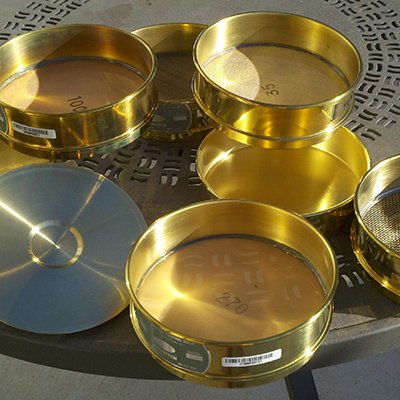
Particle size composition of sand, silt, and clay would be specified as a first provisional step in preparing a new rootzone mix. Sand sieve size is also specified, because not all sands perform the same. Organic matter quality and quantity are specified and included in the mix. The prepared provisional mixture, in small quantity, is tested in the laboratory measurement of physical properties. The physical test estimates large pore volume (macroporosity), small pore ratio (microporosity) and percolation rate measured as saturated hydraulic conductivity.
If the physical test shows that the interaction of specified components did not achieve the desired end result, components need to be adjusted, reformulated, and retested before the final rootzone mixture is prepared. These planning and preparation steps must also take into consideration whether new fields are to be flat or sloped and whether they will have internal or subsurface drainage lines.
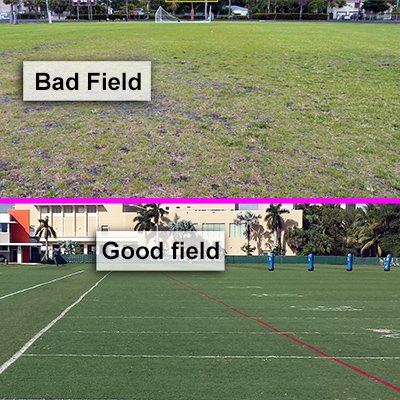
Laboratory physical measurement can also be performed for preexisting fields. In my experience from examining many fields, poor field performance is explained by inadequate particle size distribution. Sometimes other problems exist.
Soil chemistry
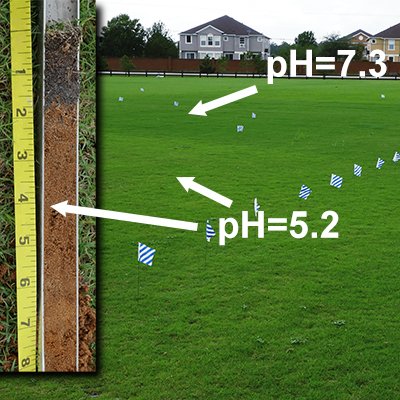
Plants obtain essential nutrients from soil, mostly metallic cations (e.g., Ca++, K+, Mg++, etc.). This depends on their availability to plant roots, which is affected by soil reaction or pH, and other factors. High soil pH makes some cations such as iron and manganese (Fe++ and Mn++) unavailable. Acidifying fertilizer, such as ammonium sulfate, can release hydrogen ions, reduce soil pH, and make iron and manganese more available. This acidification can make iron and manganese in the soil more available to plants.
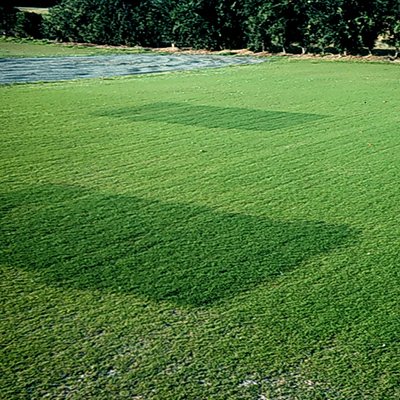
For soil pH, a smaller number is more acid, and a larger number is more alkaline. Knowing the chemistry of soil can determine whether it is appropriate to add fertilizer, lime, till, rotate crops, or amend the soil with compost or other organic matter sources. Some soil nutrients, such as potassium (K+) are labile; they decline rapidly in rootzones with high calcium (Ca++).
Soil chemical testing involves sampling, laboratory extraction of available nutrients, and interpretation. The goal is to estimate not the nutrient content but the plant availability of essential nutrient elements. The choice of a laboratory extraction protocol is important in accurately predicting nutrient availability for plants. Choices include Mehlich III, Ammonium acetate, Bray, and Olsen. Different extractants vary in their accuracy in estimating nutrient availability in soil of different pH values.
The nutrient taken up in the largest quantity from soil is nitrogen. Among all soil nutrients, nitrogen is the strongest driver of plant growth. Nitrogen has several molecular forms in soil including readily available ammonium, NH4+, and nitrate, NO3-. Most of the soil nitrogen is dynamically tied up in organic matter and released to plant roots with decomposition of organic matter. So soil tests are not adequately representative of nitrogen availability. Both nitrogen and phosphorus are pollutants if they reach surface water in large concentrations.
World soils
The Mollisols, one of the world’s twelve soil orders, sustain the most fertile and productive croplands. They developed over thousands of years due to the slow action of climate and vegetation on sediments covered by natural grass vegetation.
Other soil orders are productive for crops if managed carefully. Grassland soils, although highly fertile, are not easily suited for sports turf fields to play soccer and other sports. They have physical limitations involving water permeability and oxygen availability under heavy foot compaction.
Particle size distribution and organic matter determine the suitability of soils for various uses to grow plants. Soil health is affected by the types of crops grown, tillage, and other cultivation practices.
Rootzones in practice
Because of the need to support heavy foot traffic, golf and sports turf rootzone mixtures must be carefully designed to maintain high macroporosity. “Native sands” often fail tests for porosity and saturated hydraulic conductivity, (“drainage”) due to excessive “fines” (the smallest particles of clay, silt, and very fine sand). Fines are small enough to infiltrate macropores, especially under agitation from traffic.
High performance sports fields and golf course greens are justifiably constructed with off-site blended soil materials, sand especially, brought in from considerable distance. Refer to ASTM F2396-11(2019) Standard guide for construction of high performance sand-based rootzones for athletic fields for soil science guidance on rootzone mix for sports turf fields. For guidance on golf course greens refer to the 2004 “USGA recommendations for a method of putting green construction” (downloadable) with further construction recommendations in 2018, “Building the USGA Green: Tips for success” (available for purchase).
Geotechnical engineering
As an aside, buildings and highways must be constructed on a foundation of durable soil and rock materials. The purpose of soil in construction is so different than in growing plants that it is a separate subject called geotechnical engineering. Soil classification systems of engineers and soil scientists differ greatly. They do not speak the same language.
Both soil science and geotechnical engineering consider the physics of soil particle sizes and moisture relations. Shared terms include density, compaction, soil strength, and permeability. But the needs for soil in supporting buildings vs. growing plants are contradictory. Occasionally in construction projects the two worlds collide.